

world map with longitude and latitude pdf
Need a detailed world map for projects? Download a high-quality, printable PDF with clear latitude and longitude lines – totally free! Perfect for classrooms & travel planning.
Understanding World Maps with Latitude and Longitude
World maps displaying latitude and longitude are readily available as PDF downloads in A4 and A5 sizes.
These maps, like the Miller projection, aid in navigation and geographic studies, offering crucial positional data.
What are Latitude and Longitude?
Latitude and longitude are a coordinate system used to pinpoint any location on Earth. Latitude lines, or parallels, run east-west, measuring distance north or south of the Equator – zero degrees latitude. The Equator divides the Earth into the Northern and Southern Hemispheres.
Longitude lines, or meridians, run north-south, measuring distance east or west of the Prime Meridian – zero degrees longitude. The Prime Meridian passes through Greenwich, England, and divides the Earth into the Eastern and Western Hemispheres. Both are crucial for accurately representing locations on a world map, especially when utilizing PDF formats for download.
Understanding these lines is fundamental when working with world maps, whether in high-resolution image formats like JPG or PNG, or as downloadable PDF files in A4 or A5 sizes. These coordinates are essential for navigation, geographic positioning, and various scientific applications.
The Importance of Map Projections
Representing a three-dimensional sphere (Earth) on a two-dimensional surface (a map) inevitably introduces distortion. This is where map projections become vital. Different projections prioritize preserving specific properties – area, shape, distance, or direction – but no single projection can perfectly maintain them all.
The Miller projection, often found in PDF world map downloads, is a modified Mercator projection offering a balance between accuracy and visual appeal. The Mercator projection, while useful for navigation, distorts areas significantly, particularly near the poles. When downloading a world map as a PDF, consider the projection used and its implications.
Understanding these distortions is crucial when interpreting latitude and longitude data. Graphic scales, varying by latitude, help mitigate these inaccuracies. Choosing the right projection depends on the map’s intended use, whether for general reference or specialized analysis.
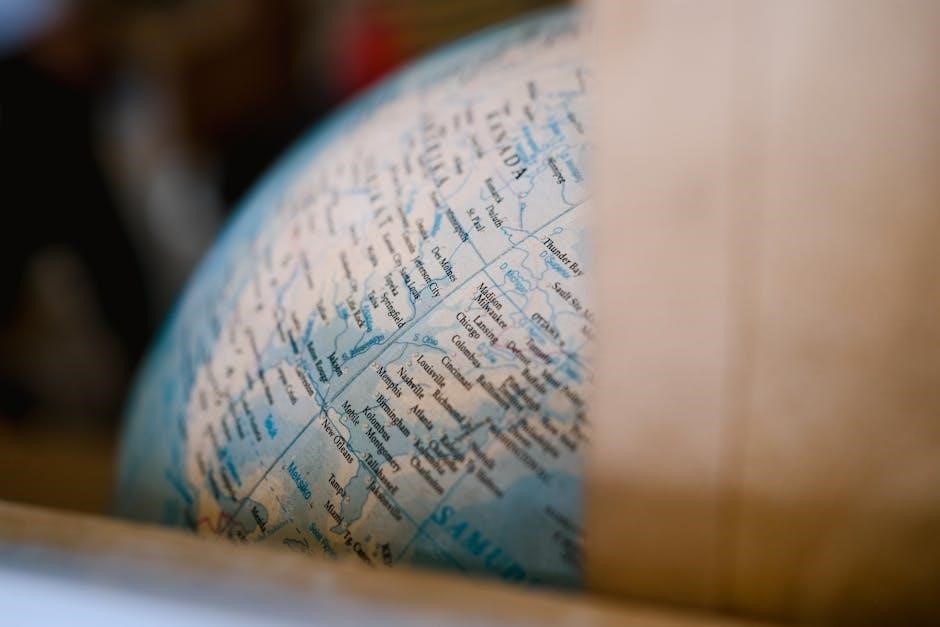
Types of World Maps Featuring Latitude and Longitude
Various world map types, available as PDF downloads, utilize latitude and longitude grids. These include Miller, Mercator, and political maps, each with unique features.
Miller Projection Maps
Miller projection maps represent a versatile choice for displaying world geography with latitude and longitude. Introduced by Osborn M. Miller in 1942, this projection offers a compromise between maintaining accurate shapes and representing areas truthfully – a challenge inherent in mapping a sphere onto a flat surface.
These maps are frequently encountered as PDF downloads, often in standard sizes like A4 and A5, making them easily accessible for educational purposes or general reference. The Miller projection is considered more visually appealing than some other projections, as it minimizes distortion, particularly in the equatorial regions.
It’s a modified Mercator projection, meaning it retains some of the Mercator’s characteristics while attempting to correct for area exaggeration. This makes it a practical option for political world maps where showing country boundaries and relative locations is paramount. Downloadable versions often include clear latitude and longitude grids for precise geographic referencing.
Mercator Projection Maps and Their Use
Mercator projection maps, while historically significant, present unique characteristics when displaying latitude and longitude. Developed in 1569, this cylindrical map projection preserves angles locally, making it invaluable for nautical navigation – a key reason for its early adoption.
However, this preservation comes at a cost: significant distortion of area, particularly at higher latitudes. Greenland, for example, appears much larger than it actually is relative to countries near the equator. Despite this, PDF versions of Mercator maps with latitude and longitude grids remain widely available.
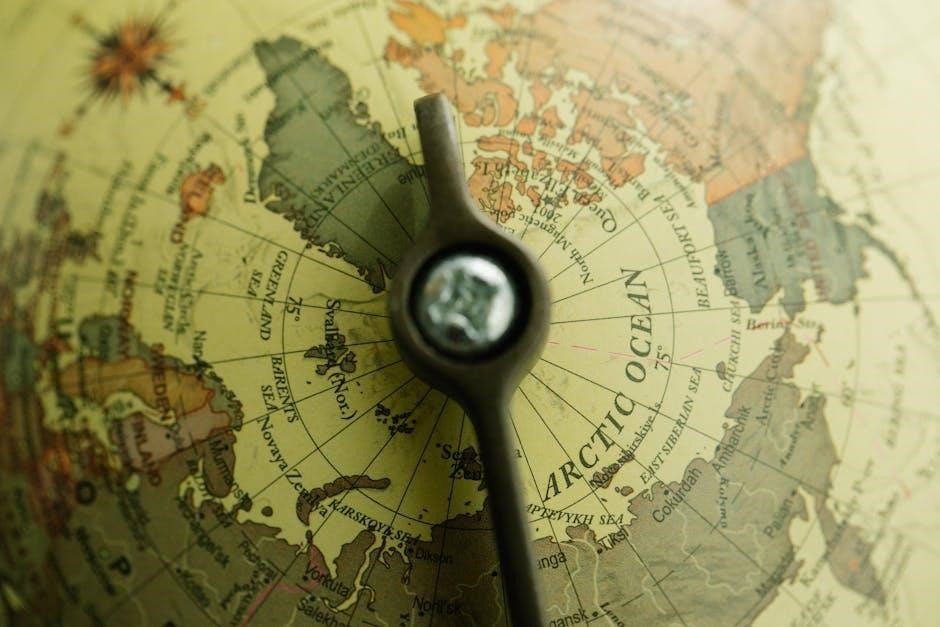
Their continued use stems from their familiarity and the ease with which straight lines can represent lines of constant bearing (rhumb lines). While the Miller projection offers a more balanced representation, the Mercator projection’s historical importance and navigational utility ensure its continued presence in cartography and downloadable map formats.
Political World Maps with Grids
Political world maps featuring latitude and longitude grids are essential tools for understanding global geography and political boundaries. These maps overlay country borders, cities, and other political features onto a coordinate system, facilitating precise location identification.
Many such maps are available as PDF downloads, often in standard sizes like A4 and A5, making them easily printable and shareable. The grid system, composed of parallels (latitude) and meridians (longitude), allows users to pinpoint locations using their coordinate values.
These maps are invaluable for educational purposes, geopolitical analysis, and travel planning. The combination of political information and geographic coordinates provides a comprehensive view of the world, enabling users to connect political events with their spatial context. Downloadable versions often include clear labeling and a legible grid for ease of use.

Downloading and Using PDF World Maps
World maps with latitude and longitude are easily downloadable as PDF files, commonly in A4 and A5 formats, for convenient access and printing.
Availability of A4 and A5 PDF Formats
The convenience of accessing detailed world maps featuring latitude and longitude is significantly enhanced through the widespread availability of Portable Document Format (PDF) versions. These digital maps are commonly offered in two standard paper sizes: A4 and A5. The A4 format (210 x 297 millimeters or 8.3 x 11.7 inches) provides a balanced view, suitable for general use, classroom settings, and reports. It offers sufficient detail without being overly cumbersome.
Conversely, the A5 format (148 x 210 millimeters or 5.8 x 8.3 inches) presents a more compact option, ideal for portability, quick reference, and inclusion in smaller documents. Both sizes maintain the map’s clarity and accuracy, ensuring that latitude and longitude lines are easily discernible. Downloading these PDFs allows users to print high-quality maps for personal or professional use, eliminating the need for large, physical maps and offering a cost-effective solution for geographic visualization.
Direct Download Links for PDF Maps
Accessing world maps displaying latitude and longitude is streamlined through direct download links, offering immediate access to valuable geographic resources. These links typically lead to PDF files, ensuring compatibility across various devices and operating systems. Users can readily obtain maps based on different projections, such as the Miller projection, which balances accuracy and visual appeal.

These downloadable PDFs are often categorized by size – A4 and A5 – catering to diverse printing and viewing preferences. The availability of these direct links simplifies the process of acquiring maps for educational purposes, travel planning, or professional applications. Furthermore, these resources frequently include clear gridlines representing latitude and longitude, facilitating precise location identification and spatial analysis. Quick access empowers users to integrate these maps seamlessly into their workflows.
Utilizing High-Resolution Image Formats (JPG, PNG, WEBP)
Beyond PDF formats, world maps featuring latitude and longitude are frequently offered as high-resolution images in JPG, PNG, and WEBP formats. These image types provide flexibility for digital integration, allowing for easy embedding in websites, presentations, and documents. JPGs are suitable for photographs and complex visuals, while PNGs excel in preserving sharp lines and text, crucial for map clarity.
WEBP, a modern image format, offers superior compression and quality compared to JPG and PNG, resulting in smaller file sizes without sacrificing detail. Utilizing these high-resolution images ensures optimal visual fidelity when displayed on various screens. They are ideal for projects requiring scalability and detailed geographic representation, offering a versatile alternative to PDF downloads for digital applications and online platforms.
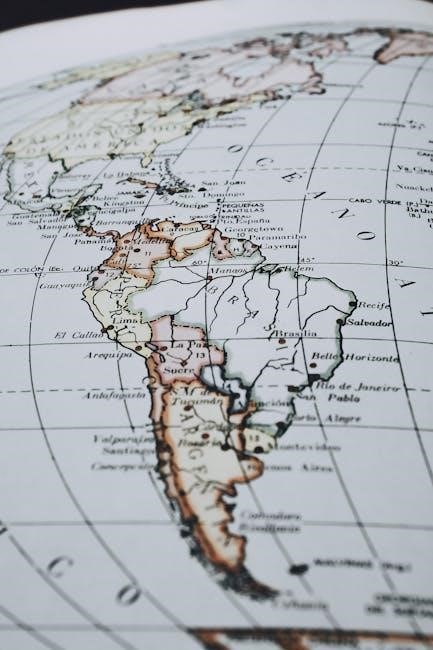
Key Features to Look for on a Latitude/Longitude Map
Essential features include the Equator (0° latitude) and Prime Meridian (0° longitude). Understanding parallels and meridians is key for pinpointing locations accurately on any world map.
The Equator (0° Latitude)
The Equator, designated as 0° latitude, is a fundamental circle dividing the Earth into the Northern and Southern Hemispheres. On a world map featuring latitude and longitude, it’s prominently displayed as the central horizontal line. Its significance stems from being the only line of latitude that is a great circle – meaning it circles the Earth with the same radius as the Earth itself.
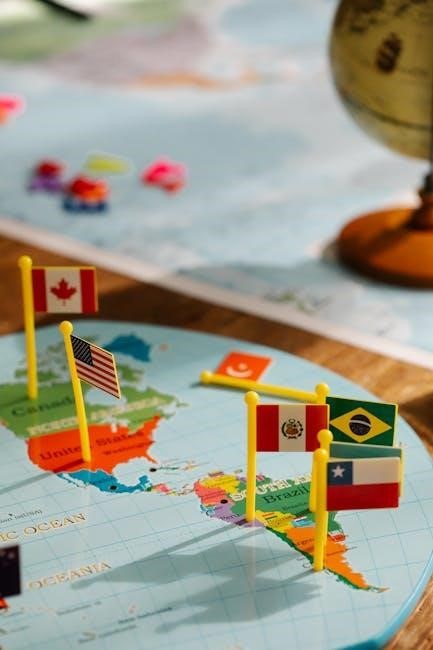
Consequently, distances along the Equator are the longest possible distances between two points on Earth measured along a parallel. When utilizing PDF world maps, observing the Equator’s position helps quickly orient oneself geographically. It serves as a crucial reference point for determining the relative locations of countries and continents.
Furthermore, the Equator experiences roughly 12 hours of daylight and 12 hours of darkness throughout the year, influencing climate patterns significantly. Understanding its role is vital when interpreting data presented on geomagnetic maps or political world maps with grids.
The Prime Meridian (0° Longitude)
The Prime Meridian, defined as 0° longitude, is the arbitrary line from which all other longitudes are measured, dividing the Earth into the Eastern and Western Hemispheres. Historically, various meridians served this purpose, but the Greenwich Meridian in London was internationally adopted in 1884. On a PDF world map displaying latitude and longitude, it appears as the central vertical line.
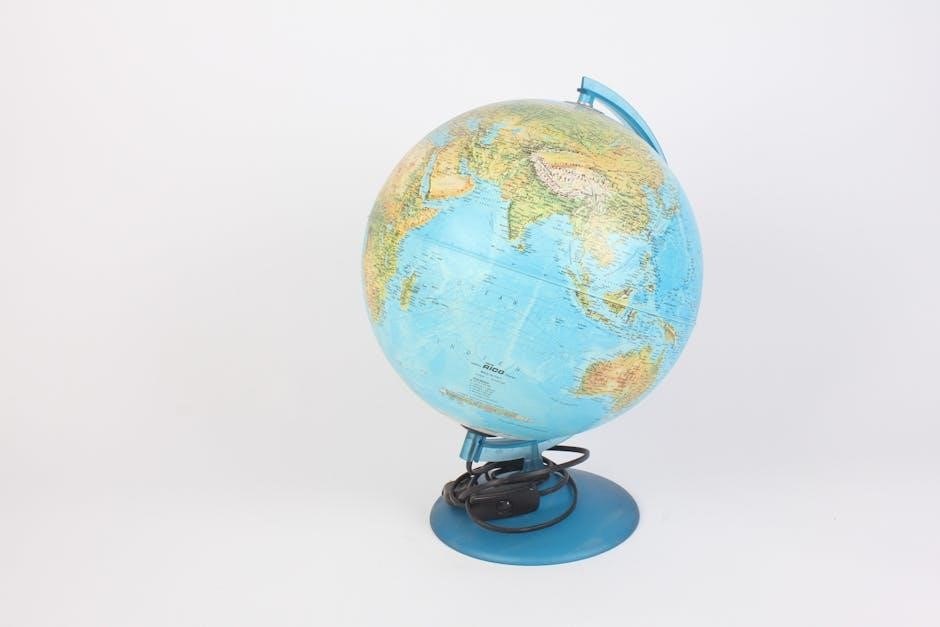
Unlike parallels of latitude, all meridians are of equal length and converge at the poles. This convergence impacts map projections, as accurately representing both latitude and longitude simultaneously presents challenges. When downloading and utilizing high-resolution image formats (JPG, PNG, WEBP) of world maps, the Prime Meridian’s placement is essential for pinpointing exact locations.
Its role is critical in establishing time zones and for precise geographic positioning, especially in navigation and geomagnetic mapping. Understanding its significance enhances the interpretation of data on political world maps with grids.
Understanding Parallels and Meridians
Parallels are lines of constant latitude, running east-west around the Earth, and are circles parallel to the Equator. Their length decreases as one moves towards the poles. Meridians, conversely, are lines of constant longitude, running north-south, converging at the poles. These lines form a grid system crucial for locating points on a PDF world map.
The spacing between meridians remains consistent, while the distance between parallels varies with latitude. This difference impacts map projections; accurately representing both requires compromises. When downloading maps in formats like JPG or PNG, recognizing this distortion is vital;
Understanding how parallels and meridians interact is fundamental for navigation, geographic positioning, and interpreting geomagnetic data. Their accurate depiction on A4 or A5 PDF maps is essential for educational resources and geographic studies, enabling precise location identification.
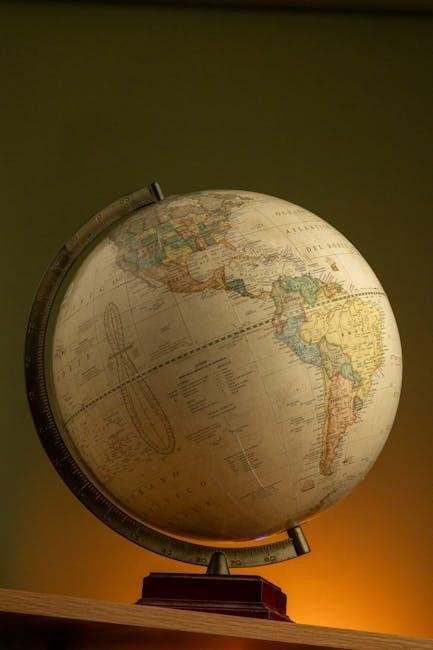
Applications of Latitude and Longitude Maps
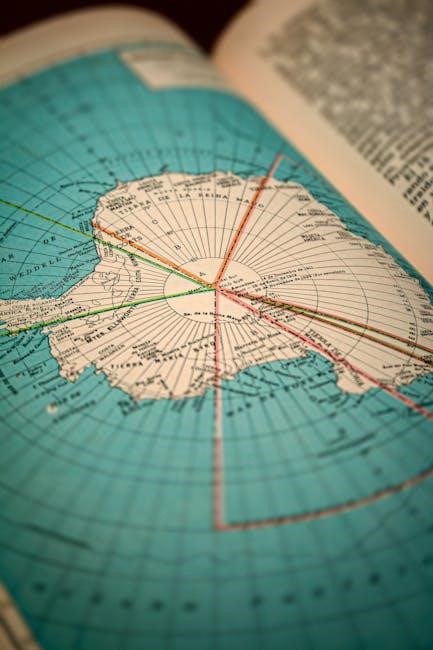
PDF maps utilizing latitude and longitude are vital for navigation, geomagnetic mapping, and data visualization. They also serve as key educational resources.
Navigation and Geographic Positioning
Latitude and longitude maps, especially those available as PDF downloads, are foundational for precise navigation across the globe. Historically, sailors and explorers relied on these coordinates to determine their position at sea, and this principle remains crucial today.
Modern Geographic Positioning Systems (GPS) directly utilize latitude and longitude to pinpoint locations with incredible accuracy. A world map displaying these coordinates provides a visual reference for understanding GPS data and planning routes. The grid system formed by parallels and meridians allows for the unambiguous identification of any point on Earth’s surface.
Whether utilizing a digital map on a smartphone or a printed PDF version, the ability to read and interpret latitude and longitude is essential for travelers, researchers, and anyone involved in geographic work. These maps facilitate efficient route planning, accurate location reporting, and a deeper understanding of spatial relationships.
Geomagnetic Mapping and Data Visualization
Beyond traditional geographic positioning, latitude and longitude maps – often accessed as convenient PDF downloads – play a vital role in geomagnetic mapping. These maps visualize the Earth’s magnetic field, crucial for understanding phenomena like auroras and magnetic declination.
Data visualization benefits significantly from the established grid system of latitude and longitude. Researchers can overlay various datasets, such as geomagnetic longitude and latitude, onto a world map to identify patterns and correlations. NOAA/NGDC and CIRES, for example, develop maps depicting geomagnetic features using this coordinate system.
The ability to accurately represent data spatially, using latitude and longitude as a framework, is essential in fields like geophysics and space weather prediction. High-resolution PDF maps provide a stable and accessible platform for analyzing and presenting complex geomagnetic information, aiding in scientific discovery and practical applications.
Educational Resources and Geographic Studies
Latitude and longitude world maps, easily obtainable as PDF files, are invaluable educational tools. They facilitate understanding of global locations, spatial relationships, and the Earth’s grid system. Students can utilize these maps to practice identifying countries, continents, and major geographical features.
For geographic studies, these maps provide a foundational layer for analyzing diverse themes – from climate patterns and population distribution to political boundaries and economic activities. The grid system allows for precise location referencing and comparative analysis across different regions.
The availability of PDF formats in sizes like A4 and A5 ensures accessibility for classroom use and individual study. Furthermore, high-resolution images (JPG, PNG, WEBP) support detailed examination and annotation. These resources empower students and researchers alike to explore and interpret the complexities of our planet.